


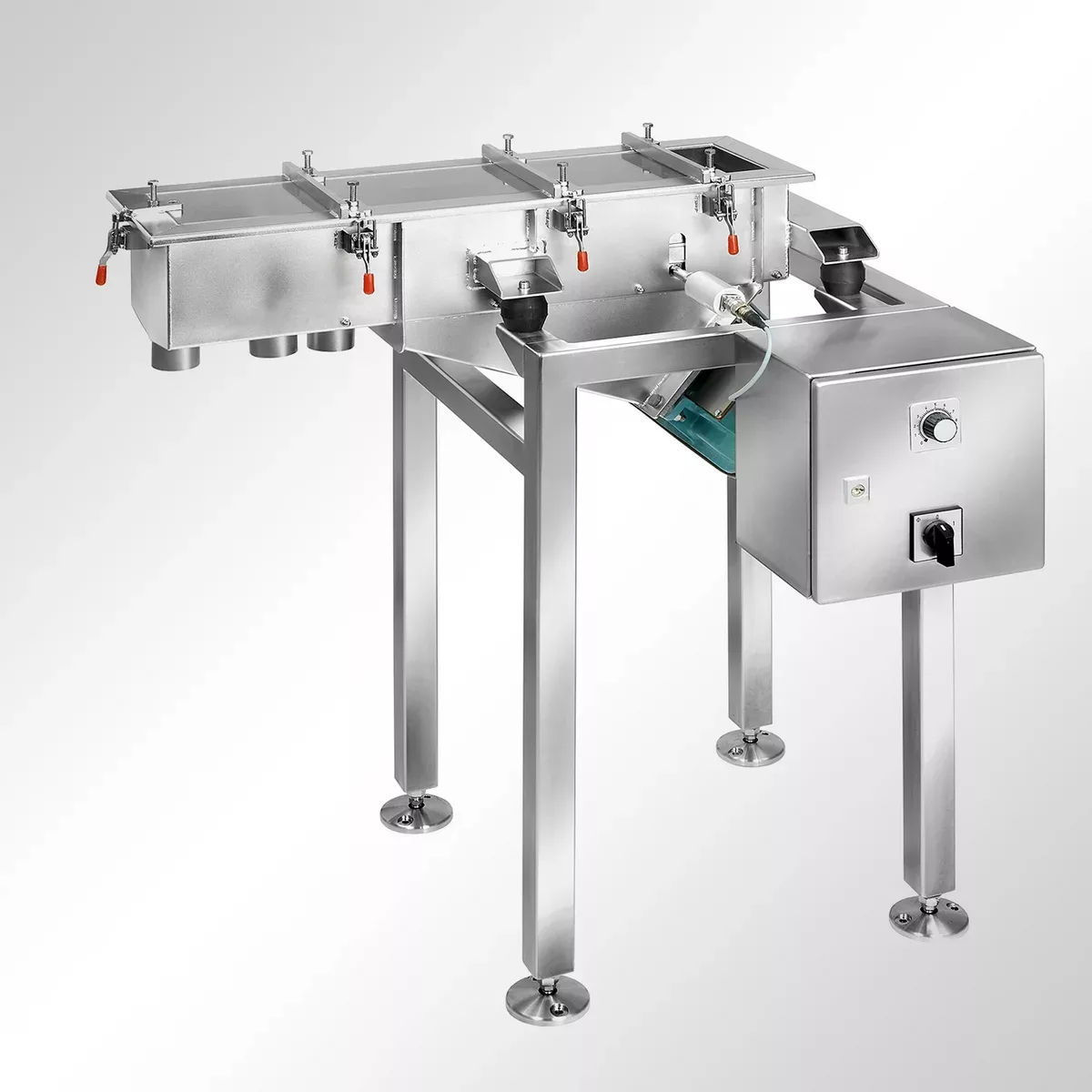
HAVER DMS Screening Machine: High-Precision Laboratory Particle Analysis
A Screening Machines Haver DMS is a magnetic-driven, double-deck laboratory sieve shaker engineered for dry classification of bulk materials ranging from 100 µm to 25 mm, delivering three precise particle size fractions simultaneously. This compact benchtop unit utilizes electromagnetic oscillation and optional ultrasonic screening aids to prevent blinding on fine meshes, ensuring sharp separations for quality control and research applications. The system replaces manual sieving with a reproducible, automated process that directly influences product quality and process stability.
Key Features and Competitive Advantages of Screening Machines Haver DMS
The Haver DMS distinguishes itself from conventional circular-throw shakers through its vertically aligned, magnetically induced linear oscillation. This unique motion controls particle dwell time on the screen surface, maximizing throughput without sacrificing accuracy. Laboratories requiring fast, clean split cuts find the following attributes critical:
-
Magnetic Drive System: Direct electromagnetic energy conversion eliminates rotating masses, reducing wear, noise, and mechanical heat transfer to the sample.
-
Double-Deck Simultaneous Classification: One screening deck stacks two screen frames (630 mm x 200 mm), producing three distinct fractions in a single dry-sieving run.
-
Adaptive Screening Aids: Integrated ball tray knockers and high-frequency ultrasonics actively clear near-mesh particles, maintaining open screen area when analyzing fine powders down to 100 µm.
-
Rapid Screen Changes: The tension-free screen frame clamp enables cleaning and mesh swapping in under 60 seconds without tools.
-
Material Versatility: Choose standard structural steel with durable powder coating for bulk minerals or full stainless-steel construction for pharmaceuticals and food-grade applications.
-
Process Reproducibility: Digital amplitude control and intermittent vibration programming store up to 99 test protocols, enforcing S.O.P. adherence across shifts.
Technical Specifications and Selection Guide
Selecting the correct lab sieve shaker demands careful alignment between your target particle cut points, particle morphology, and environmental constraints. The Haver DMS modular design supports variable frame heights and voltages, allowing integration into low-ceiling labs or vacuum conveyor networks.
HAVER DMS Technical Data
| Parameter | Specification |
|---|---|
| Screening Machine Model | HAVER DMS (Magnetic Drive) |
| Screen Frame Dimensions | 630 mm x 200 mm (L x W) |
| Particle Size Range | 100 µm to 25 mm |
| Machine Type | Double-deck (3 split cuts) |
| Screening Motion | Dry classification, linear magnetic oscillation |
| Screening Aids | Integrated ball tray, Ultrasonic module option |
| Voltage Options | 230 V / 50 Hz; 115 V / 60 Hz |
| Material Construction | Regular steel (painted) / Stainless steel |
| External Dimensions (approx.) | 1,000 mm x 600 mm (L x W), variable height |
How to Select the Right Screening Aids for Your Material
-
Ball Tray System: Use exclusively for granular materials larger than 200 µm. The bouncing rubber balls provide mechanical self-cleaning to prevent pegging.
-
Ultrasonic Generator: Essential for cohesive powders, pigments, or flour below 200 µm. Axial ultrasonic frequency breaks electrostatic bonds without damaging fragile particle structures.
-
Combined Mode: For problematic filter sands or pharmaceutical grinds containing a broad spectrum of fines and coarse grains, simultaneous ball tapping and ultrasonics deliver optimal peak-to-tail separation.
Who Should Use the Screening Machines Haver DMS?
This instrument bridges the gap between hand-sieving inaccuracies and full-scale production screening. The target audience spans industries where particle size distribution directly dictates dissolution rates, structural integrity, or abrasive reactivity.
-
Quality Control Laboratories: Cement, frac sand, and proppant producers requiring ASTM/ISO conformance certifications run shift-standardized sieve analyses with complete data traceability.
-
Pharmaceutical R&D: Powdered active pharmaceutical ingredients (APIs) and excipients demand stainless-steel contact surfaces and ultrasonic deblinding to validate particle uniformity without cross-contamination.
-
Mining & Minerals: Geotechnical labs processing cut samples from 100 µm to 25 mm leverage the double-deck advantage to isolate gangue from valuable mineral fractions quickly during exploration drilling.
-
Food & Beverage: Granulated sugar, flour, and spice processors utilize the DMS for bulk density control and foreign matter detection, benefiting from easy-wash stainless steel construction.
Best Way to Maintain and Operate the Haver DMS for Long-Term Accuracy
Proper maintenance and standardized operation form the backbone of E-E-A-T laboratory practice. A poorly maintained shaker introduces hidden systematic errors into pass/fail quality data.
-
Amplitude Verification: Use a calibrated acceleration sensor monthly to confirm the displayed amplitude matches the real vertical displacement. Deviations over 0.1 mm require drive recalibration.
-
Screen Integrity Check: Before each shift, backlight test mesh screens. A single broken wire in a 63 µm mesh invalidates the cut point and leads to undersized particle passage.
-
Cleaning Protocol: Never strike the screen frame with a hammer. Use an ultrasonic bath for fine meshes and a soft brass brush for coarse plates. Residue from previous samples causes cross-batch contamination.
-
Ball Tray Inspection: Replace rubber balls every 400 operating hours. As elastomers harden, their coefficient of restitution drops, dramatically reducing knocker cleaning efficiency.
-
Environmental Placement: Install the machine on a level, vibration-damped concrete table. External floor vibrations from crushers or mills couple into the magnetic drive and distort the cutting curve.
Frequently Asked Questions About Screening Machines Haver DMS
Why is magnetic drive used instead of motor-driven shakers?
Magnetic direct drive eliminates bearings, eccentric weights, and belts. This translates to maintenance-free operation, quieter running, and infinitely variable amplitude control without mechanical hysteresis or speed drop.
How to clean between cross-contamination-sensitive samples?
Engage the ultrasonic bath protocol for frames and apply a laboratory vacuum equipped with a HEPA filter to the housing interior. Wipe accessible magnetic gap surfaces with isopropyl alcohol.
What is the best way to select amplitude for unknown samples?
Start amplitude at 0.5 mm and incrementally increase every 30 seconds until the sieved fraction mass stabilizes. Optimal amplitude maximizes throughput while avoiding particle bouncing that re-entrains fines into the oversize fraction.
Can the Haver DMS screen wet samples?
The standard DMS operates strictly as a dry classification screen. Wet sieving requires a dedicated instrument with liquid-tight lids, corrosion-resistant gutters, and a pumped recirculation module to prevent sedimentation clogging.
Achieve Unmatched Laboratory Screening Accuracy
The Haver DMS magnetic sieve shaker delivers the sharpness of cut demanded by modern particle characterization standards. Eliminating manual tapping inconsistencies, this instrument provides the direct-defined particle fractions required for ISO 9001 and GMP reporting structures. From 100 µm pharmaceutical powders to 25 mm abrasive mineral splits, the controlled linear motion and adaptive cleaning technology protect both the screen media and the integrity of your sample.
Evaluate your current laboratory screening workflow. Contact a Haver & Boecker application specialist today to schedule a material test using your own product sample, or request a detailed technical proposal with a stainless steel configuration specifically quoted for your facility.
Reviews
There are no reviews yet.